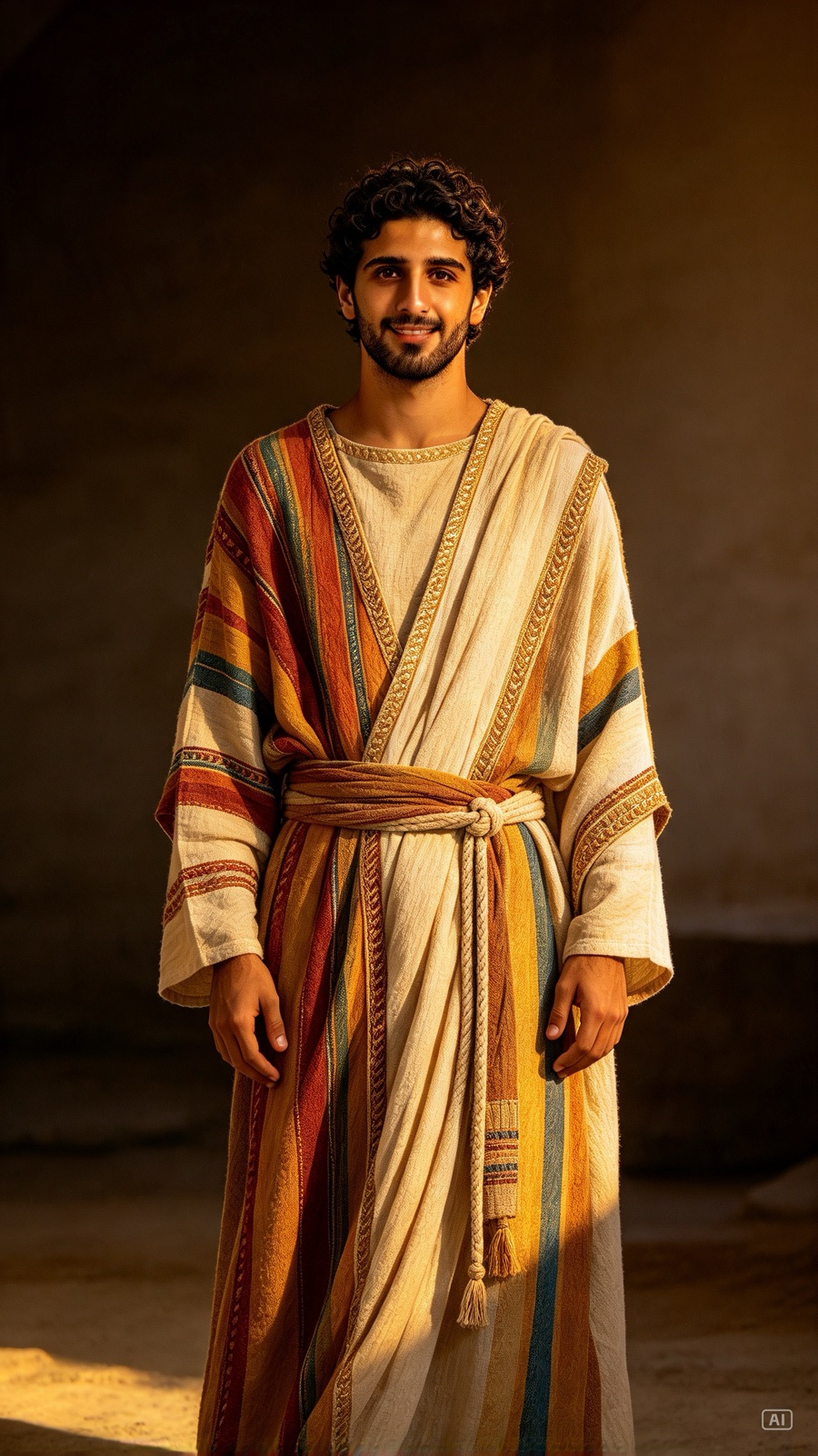
Joseph’s coat of many colors is the special garment his father Jacob (also called Israel) gave him in Genesis 37:3, “because he was the son of his old age.” The gift showed Jacob’s favoritism openly, and together with Joseph’s dreams of his brothers bowing to him it made them hate him. When Joseph was seventeen they stripped him of the coat, threw him into an empty pit near Dothan, sold him to traders for twenty pieces of silver, then dipped the coat in goat’s blood so Jacob would believe a wild animal had killed him. Joseph became a slave in Egypt, was falsely accused and imprisoned, and was finally raised by Pharaoh to rule Egypt. Years later his brothers bowed before him without recognizing him. The Hebrew phrase for the coat, ketonet passim, is uncertain: older translations say “many colors”, many modern ones say “a long robe with sleeves” or an ornamented tunic.
Joseph’s coat of many colors is one of the first Bible stories most of us ever heard, and one of the most misunderstood. The coat itself is only in one chapter. But it sets off a story of favoritism, betrayal, slavery, false accusation, power and, finally, one of the most moving scenes of forgiveness in all of Scripture.
This guide tells the whole story from Genesis 37 to Genesis 50, quotes the key verses word for word from the World English Bible, and explains what scholars and translators actually know about the famous coat.
Where the story is in the Bible
The coat of many colors is in Genesis 37, especially verses 3, 23 and 31–33. The full story of Joseph runs from Genesis 37 to Genesis 50, the last fourteen chapters of the book: the longest single story in Genesis.
Who was Joseph?
Joseph was the eleventh of the twelve sons of Jacob, and the first son of Rachel, the wife Jacob loved most. His younger brother Benjamin was Rachel’s second son; she died giving birth to him. Joseph’s ten older half-brothers were the sons of Leah and of the servants Bilhah and Zilpah. That family history is the background to everything that follows.
The Bible verse about Joseph’s coat of many colors
Now Israel loved Joseph more than all his children, because he was the son of his old age, and he made him a tunic of many colors.
Genesis 37:3 World English Bible
This is the verse most people are looking for. Notice what it says and what it does not: the coat is not a reward for anything Joseph did. It is a sign of how his father felt about him.
The story of Joseph and the coat of many colors
1. A favorite son, a report and a coat
The chapter opens with Joseph at seventeen, working with his brothers and reporting on them to his father:
This is the history of the generations of Jacob. Joseph, being seventeen years old, was feeding the flock with his brothers. He was a boy with the sons of Bilhah and Zilpah, his father’s wives. Joseph brought an evil report of them to their father.
Genesis 37:2 World English Bible
Then comes the coat, and the brothers’ reaction:
His brothers saw that their father loved him more than all his brothers, and they hated him, and couldn’t speak peaceably to him.
Genesis 37:4 World English Bible
2. The dreams
Joseph makes things worse by telling his brothers his dreams:
He said to them, “Please hear this dream which I have dreamed: for behold, we were binding sheaves in the field, and behold, my sheaf arose and also stood upright; and behold, your sheaves came around, and bowed down to my sheaf.” His brothers asked him, “Will you indeed reign over us? Will you indeed have dominion over us?” They hated him all the more for his dreams and for his words.
Genesis 37:6-8 World English Bible
A second dream includes his parents too: “the sun and the moon and eleven stars bowed down to me” (Genesis 37:9). Even Jacob rebukes him, but the narrator adds a quiet detail: “his father kept this saying in mind” (Genesis 37:11).
3. “Behold, this dreamer comes”
Jacob sends Joseph to check on his brothers, who are grazing the flocks far from home. They see him coming from a distance, and the coat would have made him easy to recognize:
They saw him afar off, and before he came near to them, they conspired against him to kill him. They said to one another, “Behold, this dreamer comes. Come now therefore, and let’s kill him, and cast him into one of the pits, and we will say, ‘An evil animal has devoured him.’ We will see what will become of his dreams.”
Genesis 37:18-20 World English Bible
4. Stripped of the coat
Reuben, the eldest, talks them out of murder and suggests the pit, planning to rescue Joseph later (Genesis 37:21-22). Then the brothers act:
When Joseph came to his brothers, they stripped Joseph of his tunic, the tunic of many colors that was on him; and they took him, and threw him into the pit. The pit was empty. There was no water in it.
Genesis 37:23-24 World English Bible
The first thing they take is the coat. Before they throw Joseph away, they remove the sign of their father’s love.
5. Sold for twenty pieces of silver
Judah said to his brothers, “What profit is it if we kill our brother and conceal his blood? Come, and let’s sell him to the Ishmaelites, and not let our hand be on him; for he is our brother, our flesh.” His brothers listened to him. Midianites who were merchants passed by, and they drew and lifted up Joseph out of the pit, and sold Joseph to the Ishmaelites for twenty pieces of silver. The merchants brought Joseph into Egypt.
Genesis 37:26-28 World English Bible
It is Judah who proposes the sale. Keep him in mind: he is the brother who changes most by the end of the story.
6. The bloodstained coat
Now the coat becomes evidence for a lie:
They took Joseph’s tunic, and killed a male goat, and dipped the tunic in the blood. They took the tunic of many colors, and they brought it to their father, and said, “We have found this. Examine it, now, and see if it is your son’s tunic or not.” He recognized it, and said, “It is my son’s tunic. An evil animal has devoured him. Joseph is without doubt torn in pieces.”
Genesis 37:31-33 World English Bible
Jacob tore his clothes, and put sackcloth on his waist, and mourned for his son many days. All his sons and all his daughters rose up to comfort him, but he refused to be comforted. He said, “For I will go down to Sheol to my son, mourning.” His father wept for him.
Genesis 37:34-35 World English Bible
There is a painful irony here. Jacob had once deceived his own father using a goat and his brother’s clothes (Genesis 27). Now his sons deceive him with a goat and their brother’s coat.
What was Joseph’s coat really like?
Here is the part most children’s Bibles skip. The Hebrew words in Genesis 37:3 are ketonet passim. Ketonet is a tunic, the long basic garment worn in the ancient Near East. The meaning of passim is uncertain.
The idea of “many colors” comes from the Greek translation of the Old Testament, the Septuagint, made in the third century BC, and from Jerome’s Latin Vulgate; the King James Version followed them, and so did the World English Bible. Other translations read the Hebrew differently:
| Translation | Genesis 37:3 |
|---|---|
| King James Version | “a coat of many colours” |
| World English Bible | “a tunic of many colors” |
| Douay-Rheims (Catholic) | “a coat of divers colours” |
| New American Bible, Revised Edition (Catholic) | “a long ornamented tunic” |
| New Revised Standard Version | “a long robe with sleeves” |
| New International Version (2011) | “an ornate robe” |
The same phrase appears once more in the whole Bible, for the robe worn by King David’s daughter Tamar:
She had a garment of various colors on her; for the king’s daughters who were virgins dressed in such robes. Then his servant brought her out and bolted the door after her.
2 Samuel 13:18 World English Bible
That second passage is why many scholars think the ketonet passim was a garment of status: long, possibly with long sleeves, possibly decorated, and not the clothing of someone who did manual work. The footnote in the New American Bible, Revised Edition makes the same point, noting that the older “coat of many colors” comes from the Greek tradition and that the robe marked honor. In the Jewish tradition, Rabbi Dr. Ari Zivotofsky surveys the rabbinic readings, from fine wool to embroidered stripes, in Jewish Action.
Whatever its colors, the meaning in the story is clear. It said, in front of ten older brothers: this one is different.
Joseph’s story told in garments
One detail makes Joseph’s story unusually easy to follow: at every turning point, someone takes his clothes or gives him new ones.
- The coat from his father marks him as the favorite (Genesis 37:3).
- The coat is stripped by his brothers and dipped in blood (Genesis 37:23, 31).
- His garment is torn away again in Egypt, when Potiphar’s wife grabs it and he runs from her (Genesis 39:12), and it becomes the false evidence that sends him to prison.
- He changes his clothing to come out of the dungeon and stand before Pharaoh (Genesis 41:14).
- Pharaoh dresses him “in robes of fine linen” with a gold chain and his own signet ring (Genesis 41:42).
Twice a garment is used to lie about Joseph. The last time, a garment tells the truth about who he has become.
What happened to Joseph after the coat?
A slave in Potiphar’s house
Yahweh was with Joseph, and he was a prosperous man. He was in the house of his master the Egyptian. His master saw that Yahweh was with him, and that Yahweh made all that he did prosper in his hand. Joseph found favor in his sight. He ministered to him, and Potiphar made him overseer over his house, and all that he had he put into his hand.
Genesis 39:2-4 World English Bible
Joseph refuses the advances of his master’s wife, and she accuses him with the garment he left in her hand. He is thrown into prison (Genesis 39).
Forgotten in prison
In prison Joseph interprets the dreams of Pharaoh’s cupbearer and baker. He asks the cupbearer to remember him, and the chapter ends with one of the loneliest lines in Genesis:
Yet the chief cup bearer didn’t remember Joseph, but forgot him.
Genesis 40:23 World English Bible
Before Pharaoh
Two years later Pharaoh has dreams no one can explain, and the cupbearer finally remembers. Joseph gives the credit away before he says a word:
Joseph answered Pharaoh, saying, “It isn’t in me. God will give Pharaoh an answer of peace.”
Genesis 41:16 World English Bible
He explains seven years of plenty and seven of famine, and Pharaoh puts him in charge:
Pharaoh said to Joseph, “Behold, I have set you over all the land of Egypt.” Pharaoh took off his signet ring from his hand, and put it on Joseph’s hand, and arrayed him in robes of fine linen, and put a gold chain about his neck.
Genesis 41:41-42 World English Bible
Joseph was thirty years old (Genesis 41:46): thirteen years after his brothers sold him.
The dreams come true
When the famine reaches Canaan, Jacob sends his sons to Egypt to buy grain. They are brought before the governor:
Joseph was the governor over the land. It was he who sold to all the people of the land. Joseph’s brothers came, and bowed themselves down to him with their faces to the earth. Joseph saw his brothers, and he recognized them, but acted like a stranger to them, and spoke roughly with them. He said to them, “Where did you come from?” They said, “From the land of Canaan, to buy food.” Joseph recognized his brothers, but they didn’t recognize him.
Genesis 42:6-8 World English Bible
The brothers bow to the ground, exactly as in the dream of the sheaves. They do not recognize him. He recognizes them.
How the story ends: “I am Joseph”
Joseph tests his brothers, and the test turns on Benjamin, the youngest, now the father’s favorite in Joseph’s place. When Benjamin is about to be taken as a slave, Judah, the brother who once proposed selling Joseph, offers himself instead:
Now therefore, please let your servant stay instead of the boy, my lord’s slave; and let the boy go up with his brothers. For how will I go up to my father, if the boy isn’t with me?—lest I see the evil that will come on my father.”
Genesis 44:33-34 World English Bible
Joseph cannot hold back any longer:
Then Joseph couldn’t control himself before all those who stood before him, and he called out, “Cause everyone to go out from me!” No one else stood with him, while Joseph made himself known to his brothers. He wept aloud. The Egyptians heard, and the house of Pharaoh heard. Joseph said to his brothers, “I am Joseph! Does my father still live?” His brothers couldn’t answer him; for they were terrified at his presence.
Genesis 45:1-3 World English Bible
Joseph said to his brothers, “Come near to me, please.” They came near. He said, “I am Joseph, your brother, whom you sold into Egypt. Now don’t be grieved, nor angry with yourselves, that you sold me here, for God sent me before you to preserve life.
Genesis 45:4-5 World English Bible
Years later, after Jacob’s death, the brothers are still afraid that Joseph will take revenge. His answer is one of the best-known verses in the Old Testament:
Joseph said to them, “Don’t be afraid, for am I in the place of God? As for you, you meant evil against me, but God meant it for good, to save many people alive, as is happening today. Now therefore don’t be afraid. I will provide for you and your little ones.” He comforted them, and spoke kindly to them.
Genesis 50:19-21 World English Bible
What does the story of Joseph’s coat mean?
Favoritism wounds a whole family
Genesis does not hide the father’s part. Jacob loved one son “more than all his children” and made it visible. The coat did not create the brothers’ hatred, but it put it on display every day.
God is at work in the worst chapters
Joseph never says that what his brothers did was good. He says: “you meant evil against me, but God meant it for good” (Genesis 50:20). The story holds both things at once: real wrong, and a God who brings life out of it.
People can change
The brothers who sold Joseph are not the same men at the end. Judah, who once said “let’s sell him”, offers his own freedom for Benjamin. Forgiveness in this story is not pretending nothing happened; it comes after the truth is faced.
Joseph and Daniel
If you know the story of Daniel in the lions’ den, you will notice how alike the two men are: young exiles in a foreign court, faithful when no one is watching, interpreting a king’s dreams and giving the credit to God, and raised to the highest office in a foreign empire. Many readers see Joseph as the pattern the Book of Daniel follows.
How to read Joseph’s story with a group or your family
- Jacob gave Joseph a coat his brothers did not have. Where have you seen favoritism damage a family, a team or a church?
- Joseph told his dreams to the people most likely to resent them. What is the difference between honesty and wisdom?
- Joseph was forgotten in prison for two years. What helps you keep faith when nothing seems to change?
- Read Genesis 37:26-27 and 44:33-34 side by side. What has changed in Judah?
- What is the difference between saying “what you did was fine” and saying “God meant it for good”?
For children, the story fits in a few sentences: Joseph’s brothers were jealous of his special coat and sent him away. God was with Joseph in every hard place, and when his brothers came to him hungry, he forgave them and took care of them.
Joseph’s coat of many colors: movie and video
There have been several films and musicals about Joseph, the best known being the stage musical Joseph and the Amazing Technicolor Dreamcoat, which is a light retelling rather than a word-for-word one. Our series Joseph: The Dreamer follows Genesis 37–50 in short cinematic episodes and quotes Scripture word for word. (Bible Saga is our app, so we are recommending our own work.)
Frequently asked questions
Where is the coat of many colors in the Bible?
In Genesis chapter 37. Jacob gives Joseph the coat in verse 3, the brothers strip it from him in verse 23, and they dip it in goat’s blood and show it to Jacob in verses 31 to 33.
Why did Jacob give Joseph a coat of many colors?
Genesis 37:3 gives the reason: Jacob “loved Joseph more than all his children, because he was the son of his old age.” Joseph was also the first son of Rachel, the wife Jacob loved most.
Why did Joseph’s brothers hate him?
For three reasons the text names: their father loved Joseph more and showed it with the coat (Genesis 37:4), Joseph brought a bad report about them to their father (37:2), and he told them dreams in which they bowed down to him (37:8).
Was Joseph’s coat really multicolored?
Nobody knows for certain. The Hebrew phrase ketonet passim is uncertain. The Greek Septuagint and the Latin Vulgate translated it as a garment of many colors, and the King James Version followed them. Many modern translations read it as a long robe with sleeves or an ornamented tunic, a garment of status, like the robe of the king’s daughters in 2 Samuel 13:18.
How old was Joseph when his brothers sold him?
Seventeen (Genesis 37:2). He was thirty when he stood before Pharaoh (Genesis 41:46), so about thirteen years passed between the pit and the palace.
How much was Joseph sold for?
Twenty pieces of silver (Genesis 37:28).
What happened to the coat of many colors?
The brothers killed a male goat, dipped the coat in its blood and brought it to Jacob, who concluded that a wild animal had torn Joseph to pieces (Genesis 37:31-33). The Bible does not mention the coat again.
Did Joseph forgive his brothers?
Yes. He revealed himself to them in Genesis 45, and after their father’s death he reassured them: “you meant evil against me, but God meant it for good, to save many people alive” (Genesis 50:20).
Sources
- The Bible: Genesis 27, 37, 39–42, 44–45, 50 and 2 Samuel 13, quoted from the World English Bible (public domain); translation comparison from the King James Version, Douay-Rheims, NABRE, NRSV and NIV.
- “Joseph”, Encyclopaedia Britannica. britannica.com
- Genesis 37 with notes, New American Bible, Revised Edition, United States Conference of Catholic Bishops. bible.usccb.org
- Ari Z. Zivotofsky, “What’s the Truth about… Joseph’s ‘Amazing Technicolor Dreamcoat’?”, Jewish Action. jewishaction.com